A new category of savings product hit mainstream financial press this month.
Aave — one of the largest institutional lending platforms in the world — launched a consumer savings app directly on the iOS App Store in the US. It pays over 5%. It connects to regular US banks. No specialist knowledge required. The US Senate reached a bipartisan deal to restrict these products for American users. Circle's stock dropped 18%.
If you're based in the UAE and wondering what any of this has to do with you: more than you'd think, and in your favour.
What these savings apps actually are
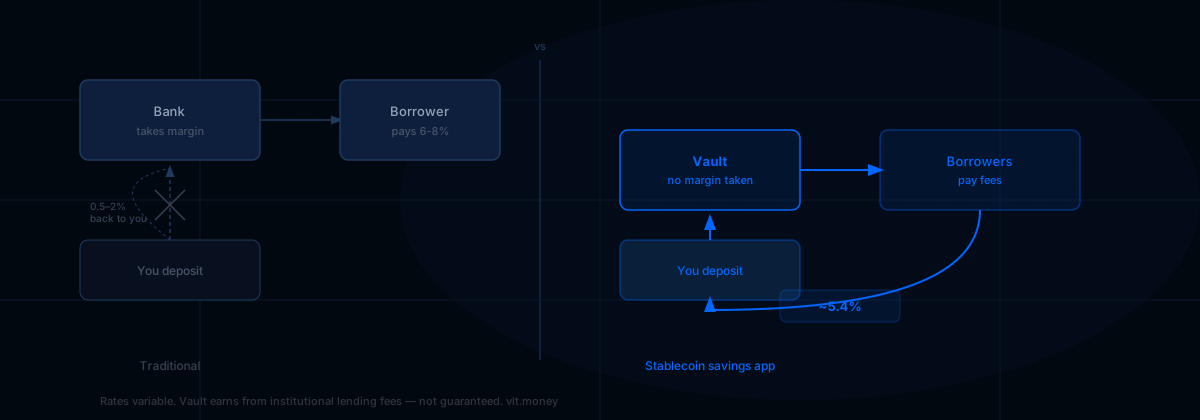
Traditional banks take your deposit, lend it out at 5–8%, pay you 0.5–2.5%, and keep the rest.
These new apps route your money directly into the same lending side — institutional borrowers, short-term liquidity, real fees — without the bank in the middle taking the margin. The fees borrowers pay flow back to you.
You don't need specialist knowledge. You don't need technical setup. What you see is: a savings account. A rate. A balance. Deposit and withdraw whenever you want.
The infrastructure underneath is different. The interface isn't.
Why the category exists now
Institutional lending markets have matured over the past several years. Businesses and financial institutions borrow short-term capital, pay fees for access, and repay. These markets have operated at scale — hundreds of billions in volume.
Until recently, the only way to access them required specialist knowledge most people don't have. The category shift is about removing that barrier. The underlying market is the same. The user experience is a simple savings app.
Aave just proved it works at scale
Aave launched its consumer savings app on the iOS App Store this month. 5% base rate. Connections to 12,000+ US banks. No specialist knowledge required. Real-time balance updates. A $1M protection layer for depositors.
This is the same model that Vault is building — just for a different market. Aave's app is US-only. It's proof that the model works for mainstream users. It's a savings account that happens to run on different infrastructure.
Why US restrictions make the UAE more valuable
The US Senate reached a bipartisan compromise on March 20, 2026 restricting passive earnings on certain digital savings products for US users. The bill is heading to markup. It has White House backing.
This means American users will soon be legally restricted from using products like Aave's savings app — or anything equivalent. US-based platforms will be forced to remove earnings from these products.
The category doesn't disappear. Demand for USD-denominated returns at rates higher than 0.5% doesn't disappear. What changes is where that demand has to go.
The UAE is that place. USD-pegged currency. Large international workforce. ADGM and VARA actively building regulatory frameworks for exactly this type of product.
Where Vault fits
Vault is a lending-market savings app built for UAE residents and the broader MENA market.
Deposits flow into a vetted institutional lending market, where institutional borrowers pay fees for short-term liquidity. Those fees are what you earn. The current rate is approximately ~5.4% (variable — it moves with borrower demand, not a fixed promise from Vault).
Vault is in the process of obtaining ADGM regulatory approval. The goal: a fully regulated, simple savings product that earns more than a UAE bank account without requiring any specialist knowledge.
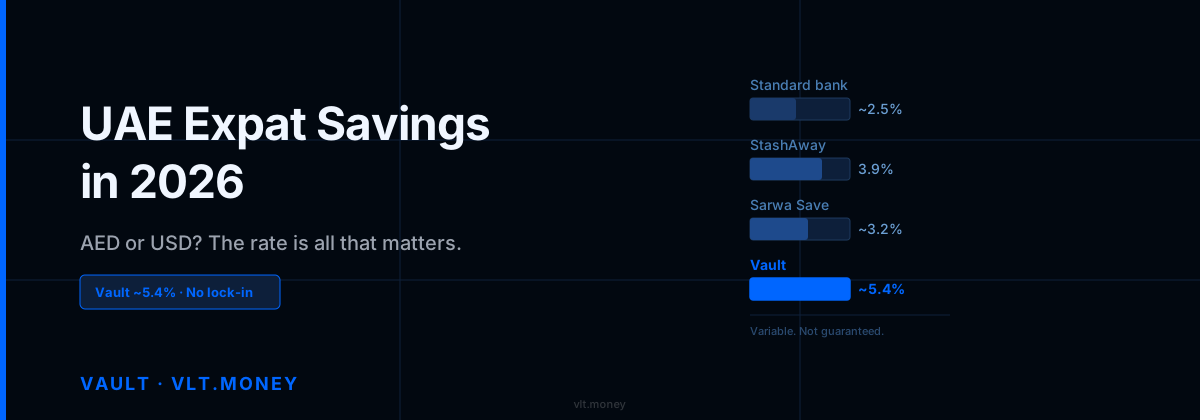
The best flexible savings rate available in the UAE right now — no lock-in, no salary routing conditions — is StashAway Simple at 3.6%. FAB's iSave offers 4% on new funds until June 30, 2026, but standard FAB balances earn around 2.5%. Vault's ~5.4% sits well above both.
The short version
A new category of simplified high-rate savings is real and validated. Aave proved the model in the US. The US Senate just restricted access to it for Americans, which makes UAE — with its dollar-pegged economy and developing digital finance framework — the clearest global venue for this product.
You don't need to understand any of the technical detail to use one. You need a UAE residence, a savings target, and a preference for earning more than 3%.
Join the waitlist at vlt.money
Vault earnings are fees paid by institutional borrowers — not guaranteed returns. Rates are variable and currently approximately ~5.4%. Vault is in the process of obtaining ADGM regulatory approval.