Most financial advice says keep three to six months of expenses in an emergency fund. For UAE expats — without the social safety net of a home country, often a long way from family — six months is the more sensible target.
The standard advice stops there. It doesn't tell you what to do with the money once you've saved it. And in the UAE, that gap costs people real money.
What an Emergency Fund Is For
An emergency fund is not an investment. It is a buffer: job loss, medical cost, flight home, broken lease. The rules are simple:
- It has to be accessible immediately. Not next week. Today.
- It cannot lose value. You cannot afford to find it down 20% when you need it most.
- It should not be hard to use. No apps with five-day settlement delays. No paperwork.
These requirements rule out most investments — stocks, fixed deposits, property. They also rule out, for most people, doing nothing.
The Problem With Doing Nothing
The average UAE expat salary is AED 16,000–20,000 per month. Six months of expenses — rent, food, transport, dependents — can easily reach AED 60,000–100,000 for a family household.
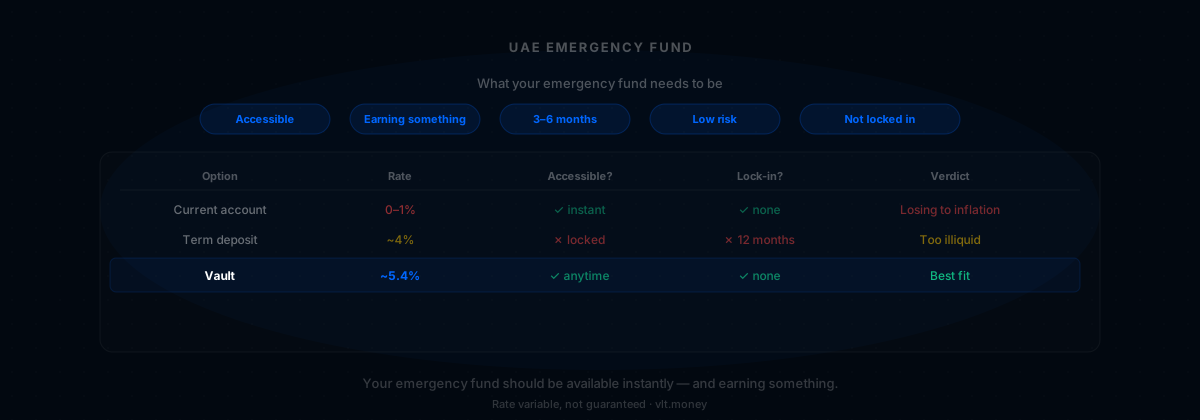
That money sitting in a current account earns roughly 0–0.5%. On AED 80,000, that is AED 0–400 per year.
A UAE savings account — if you qualify for the headline rate, which usually requires salary routing, a minimum balance, or both — might get you 1–2%. On the same AED 80,000: AED 800–1,600 per year.
Still leaving significant money on the table.
What UAE Banks Actually Pay on Flexible Savings
The honest picture of UAE savings rates in 2026:
- Standard savings accounts: 0.5–1.5% — widely available, no conditions
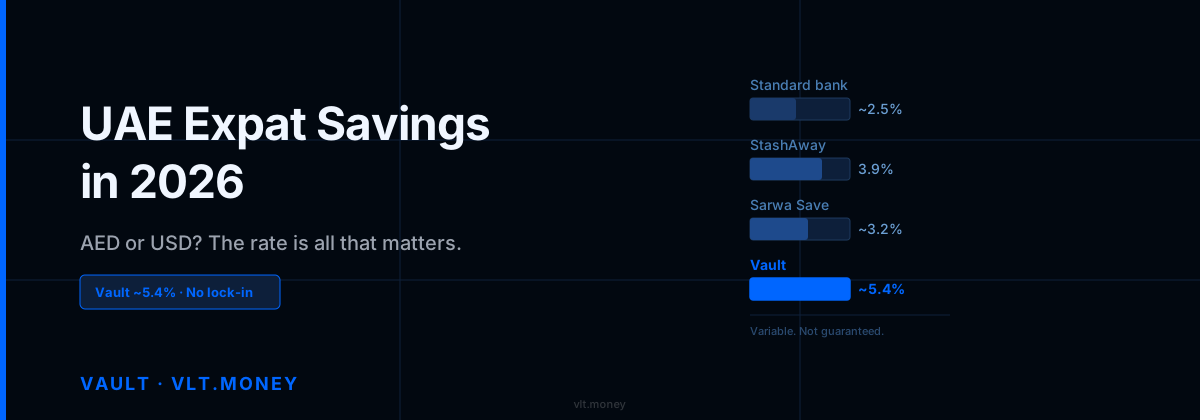
- Digital bank flexible accounts: 3.25–5% — Wio (3.25%), Mashreq NEO PLUS (up to 5% with AED 50K balance, but withdrawals capped at 2/month)
- Promotional rates: 4–6.25% — always come with conditions (salary, minimum balance, lock-in) and typically end after 3–6 months
Most UAE residents don't qualify for the headline rates. Or they qualify, earn the promo rate for a quarter, and then the rate quietly drops.
The other issue: lock-in periods. Fixed deposits at UAE banks pay 3.5–4.25%, but they require you to keep money locked for 3–12 months. An emergency fund locked in a 12-month FD is not an emergency fund. It is a savings product wearing the wrong label.
The Specific Problem for UAE Expats
The UAE has no deposit protection scheme equivalent to the UK's Financial Services Compensation Scheme or the US FDIC. UAE bank deposits are not explicitly government-guaranteed up to a set limit in the same way.
More practically: UAE expats often have no local credit history, no family safety net nearby, and often a visa status tied to employment. If you lose your job, your visa clock starts. You need accessible cash, fast. An emergency fund locked behind salary routing conditions, notice periods, or slow withdrawal processes is a liability, not an asset.
What "Withdraw Anytime" Actually Means
Vault keeps your money in a vetted institutional lending market that earns fees from borrowers. The current rate is ~5.4% (variable, not guaranteed). More importantly: you can withdraw anytime. No lock-in. No notice period. No penalty.
That combination — better rate than most UAE flexible savings accounts, genuine liquidity — is exactly what an emergency fund needs.
On AED 80,000 at ~5.4%: roughly AED 4,300 per year. The difference between that and a standard current account is AED 3,900. Every year. Sitting idle.
A Simple Framework
| Emergency fund size | Current account (0.5%) | UAE savings account (1.5%) | Vault (~5.4%) |
|---|---|---|---|
| AED 30,000 | AED 150/yr | AED 450/yr | ~AED 1,620/yr |
| AED 60,000 | AED 300/yr | AED 900/yr | ~AED 3,240/yr |
| AED 100,000 | AED 500/yr | AED 1,500/yr | ~AED 5,400/yr |
All figures approximate. Vault rate is variable, not guaranteed.
The Trade-Off Worth Knowing
Vault's rate moves with lending market conditions — it is not a fixed return. Some months it will be higher; some lower. If certainty matters more than rate, a standard savings account has a predictable (if lower) return.
But for an emergency fund — money that you hope never to touch — earning more on idle cash while staying liquid is exactly the right trade-off.
Practical Setup
Keep one to two weeks of expenses in your current account for daily spending. Put the rest of your emergency buffer somewhere it earns more without locking you in. Review it once a year — adjust the amount as your expenses change.
That is the full emergency fund strategy. It does not require a financial adviser, a brokerage account, or any understanding of markets. Just a decision to stop leaving money idle.
Join the waitlist at vlt.money
Vault earnings are fees paid by institutional borrowers — not guaranteed returns. Rates are variable. Vault is in the process of obtaining ADGM regulatory approval.