In May, roughly 10,000 financial leaders are flying to Dubai for the Dubai FinTech Summit. In December, Abu Dhabi hosts Abu Dhabi Finance Week at the same time as GITEX — 200,000+ attendees, 1,200 investors, and the world's largest gathering of digital finance and fintech talent, all in one week.
This is not a coincidence. The UAE has deliberately positioned itself as the place where financial innovation happens. And if you live here, that matters — not as an abstract fact, but for the financial products available to you right now.
What the UAE actually built
While most jurisdictions spent the last three years trying to figure out how to regulate digital financial products, the UAE built the infrastructure.
The Abu Dhabi Global Market (ADGM) and Dubai's VARA both have active, live frameworks for digital asset companies. Not pending. Not "in consultation." Operational, with licensed entities and real enforcement.
Binance received a global ADGM licence in January 2026. The Solana Foundation established an official UAE chapter in 2025. Solana City Dubai opened as a physical hub for financial technology founders. Institutional players from Barclays to Goldman Sachs are regulated in ADGM.
This happened because UAE regulators made deliberate decisions: create clear rules, move quickly, and welcome serious financial companies that want to operate properly.
Why this diverges from everywhere else
Compare that to the US, where legislators are actively restricting what financial products residents can access — including proposals that would make certain savings products unavailable to American consumers entirely.
The UK has its own wave of tightening. Singapore is cautious. Hong Kong is moving, but slowly.
The UAE is not restricting. It is building.
That creates a window. Products that are not available — or are actively restricted — in other major markets are accessible here, legally, under a proper regulatory framework.
What it means for a regular saver
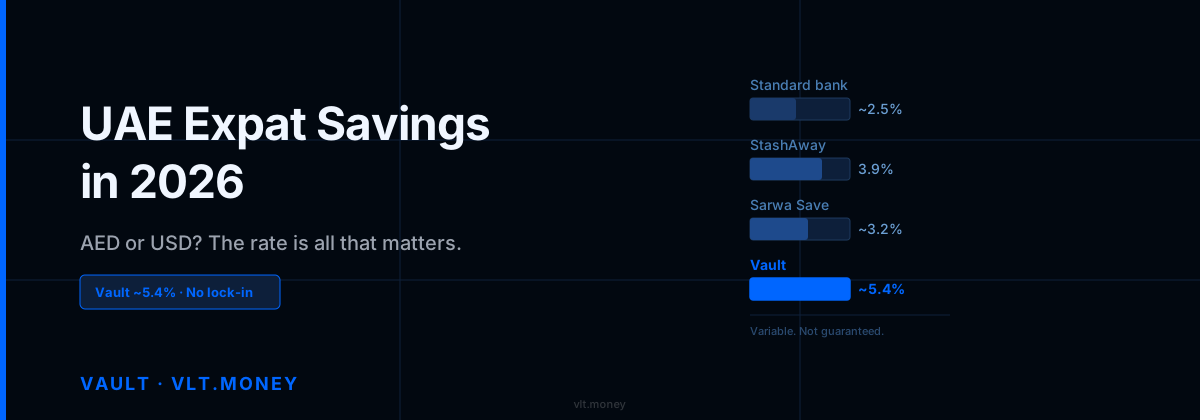
The practical result is this: the same types of institutional lending markets that generate 5–8% returns for funds and financial institutions are accessible to individuals in the UAE in a way they are not in most other markets.
Banks in the UAE pay you 1–2% on savings. That's what banks pay when they have no competition for your deposits.
The competition now exists here, because the regulatory environment permits it.
Vault is one example: your deposits earn fees from institutional borrowers via vetted lending markets, at rates that move with market demand rather than a central bank's monetary policy decisions. That product is possible in the UAE. In many other markets right now, it isn't.
Why "where your product is built" matters
When you deposit money with any financial product, you're trusting its structure. Not just the technology — the legal entity, the regulatory jurisdiction, the rules that apply if something goes wrong.
ADGM has internationally recognised standards, strong oversight, and a track record. When a fintech company says it's pursuing ADGM regulation, that means something: it's volunteering to meet a high bar, in a jurisdiction where the bar is real.
That is a different proposition to a product incorporated in a jurisdiction with no regulator, or in a country that has chosen opacity over accountability.
The point
The UAE became a fintech capital because it chose to. That choice created conditions that benefit everyone who lives here — including those who just want a better place to put their savings than an account paying 1.5%.
The next wave of financial products will be built here. Some of them are already live.
Join the waitlist at vlt.money
Vault earnings are variable fees paid by institutional borrowers — not guaranteed returns. Vault is in the process of obtaining ADGM regulatory approval.