If you're looking for a place to earn on idle money — without locking it up — you've probably come across both Lulo and Vault. They're in the same category: flexible savings, competitive rates, no banks involved.
But they're not the same product. Here's the real comparison.
The Rate
Lulo runs two tiers. Protected and Boosted.
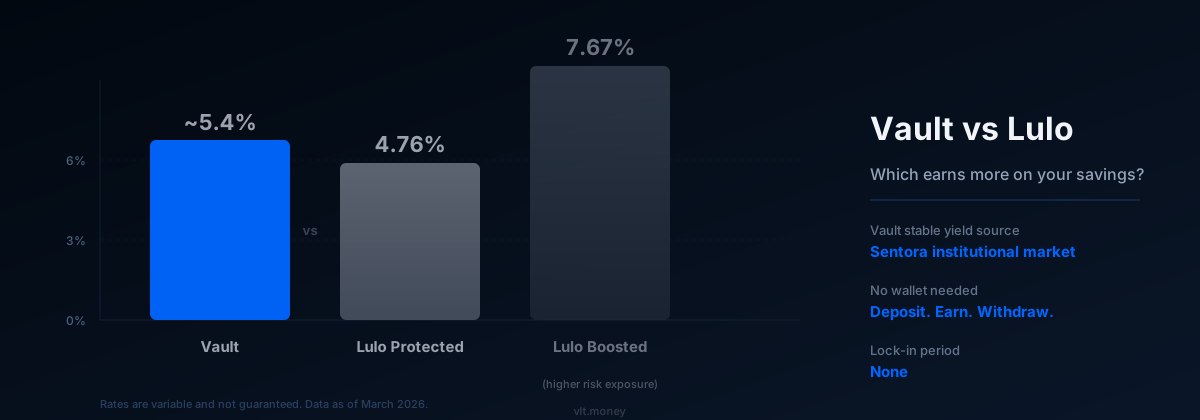
Lulo Protected: 4.76%
This is their flagship safe option. It invests across multiple lending markets to stay stable. In January 2026, it was at 5.04%. By March it had dropped to 4.76%.
Lulo Boosted: 7.67%
Higher rate, but it takes on more market exposure. The rate moves more, and the risk profile is different.
Vault: ~5.4% current
Vault earns from fees paid by institutional borrowers through a focused institutional lending market. The rate moves with borrower demand, but the source is one consistent, institutional market. Not a blend of different market exposures.
At 5.4% vs 4.76%, Vault's current rate is now ahead of Lulo Protected.
Where the Rate Comes From
This is the more important difference.
Lulo Protected works by spreading deposits across multiple Solana lending markets — Kamino Prime, Jupiter, Drift, MarginFi — and blending the output. Diversification, yes. But also complexity: you're exposed to the performance of multiple lending markets, and when those rates move, so does your return.
Vault uses a single source: a focused institutional lending market. Borrowers are institutions, not retail. The rate reflects real market demand, not a blended average of whatever's available.
Simple. Consistent. Institutional.
Accessibility
Lulo requires a Solana account and some understanding of how to navigate its interface. You need to know which tier to pick, what the lending markets underneath mean, and how to manage your position.
Vault requires none of that. You deposit AED or USD. Your money earns. You withdraw when you want. No account setup. No market research. No decisions beyond "how much."
The target user is different. Lulo is built for people who actively manage lending positions. Vault is built for people who understand savings — and want a better version of what banks offer.
Total Deposits as a Signal
Lulo's total deposits have shifted significantly. In earlier data, Lulo was tracking $95–112M. At last check, it was $21.69M — $9.61M in Protected, $12.07M in Boosted.
That's a meaningful drop. It likely reflects a combination of users chasing higher rates elsewhere as Lulo's stable tier compressed, and market normalisation.
Total deposits aren't everything. But when the rate falls and deposits leave, the market is voting.
When Lulo Makes Sense
Lulo Boosted at 7.67% is a real number. If you want more rate and you're comfortable with actively managed lending positions and more volatility — Lulo Boosted is a legitimate option.
Vault isn't trying to compete with that. Vault is trying to compete with what most people are actually using: UAE bank savings accounts paying 1–2%, term deposits with lock-ins, FAB promo rates that expire.
Compared to those, both Vault and Lulo win. But if you're in the UAE and you want the simplest path to a competitive return — Vault is the better fit.
The Summary
| Vault | Lulo Protected | Lulo Boosted | |
|---|---|---|---|
| Current rate | ~5.4% | 4.76% | 7.67% |
| Lock-in | None | None | None |
| Earnings source | Single institutional market | Blended lending markets | Higher-risk market blend |
| Setup complexity | Simple deposit | Solana account required | Solana account required |
| Target user | UAE savers | Tech-comfortable | Advanced users |
Rates are variable and not guaranteed.
Join the waitlist at vlt.money
Vault earnings are fees paid by institutional borrowers — not guaranteed returns. Rates are variable. Vault is in the process of obtaining ADGM regulatory approval.