Most people comparing savings apps start with the rate. The rate matters — but it's the last thing to check, not the first.
Here are four questions worth asking before you deposit anywhere.
1. Who actually holds your money?
At a bank, the bank holds your money. You're an unsecured creditor. If the bank fails, you're in the queue.
Some savings apps work differently. Rather than holding your funds in a pooled account, they route your money directly into lending markets. The app is a router, not a custodian.
Neither model is inherently better — but you should know which one you're using, because the risk profile is different.
With a custodial model, you're exposed to the solvency of the company. With a non-custodial model, you're exposed to the performance of the underlying markets.
Ask: Where does my money go after I deposit?
2. Who are the borrowers?
If your money is being lent out, you should know who's borrowing it and under what terms.
The safest lending structures use over-collateralisation: borrowers must pledge assets worth more than they borrow. If a borrower defaults, the collateral is liquidated before depositors feel it. You're not extending unsecured credit — you're participating in a structured lending market.
Compare that to models built on consumer credit: personal loans, BNPL, salary advances. These can work, but the risk profile is fundamentally different. Defaults hit depositors more directly.
Ask: Are the borrowers institutional? Is there collateral?
3. Is the rate real — or a promotion?
There's a difference between a market rate and a promotional rate.
A market rate moves with demand. When borrowers want more liquidity, rates go up. When demand falls, rates adjust. It's variable — but it's driven by real activity.
A promotional rate is a subsidy. The company is paying you above-market returns to attract deposits. That's fine, temporarily. But promotions end. The relevant question isn't the rate during the promo — it's what you earn afterward.
We've seen major UAE banks offer 4–6% on savings accounts, then revert to 0.5–1% once the campaign ends. The customers who didn't check got caught.
Ask: Is this rate market-driven or time-limited? What happens when it ends?
4. Is the company regulated — or honest about where it stands?
Regulation in financial services matters. Regulatory frameworks require capital buffers, audits, disclosures, and consumer protections. They're not perfect, but they exist for a reason.
Not every savings product is regulated. Some operate in jurisdictions with lighter frameworks. Some are in the process of obtaining authorisation.
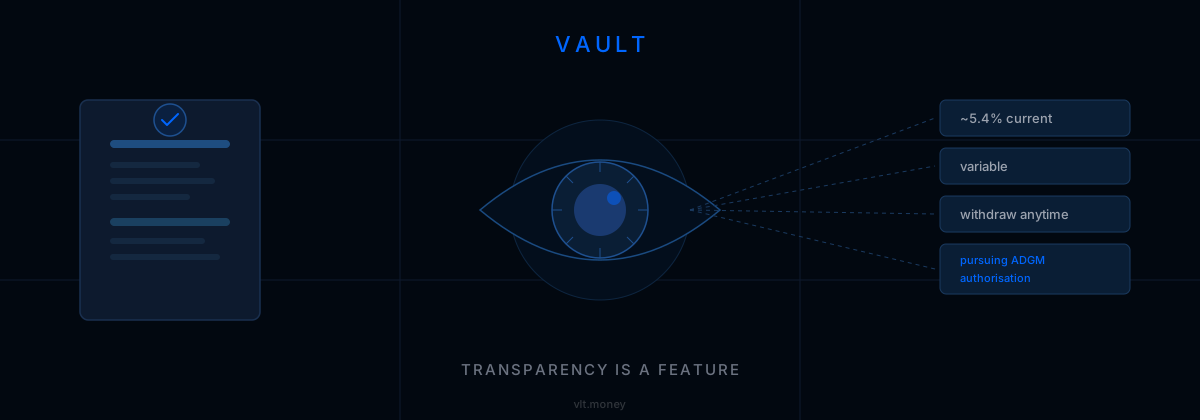
The honest version of this: Vault is built by Prometheus Labs, which is pursuing ADGM authorisation in Abu Dhabi. We are not yet licensed. We say that publicly, because trust starts with being accurate about where you are.
The red flag isn't "not yet regulated." The red flag is a company that won't tell you either way.
Ask: Is the company regulated? If not, are they pursuing it — and where?
The summary
Before depositing in any savings product, check:
- Custody: Who holds your money, and what happens if the company fails?
- Borrowers: Who's borrowing, and is the lending structure over-collateralised?
- Rate source: Is this a market rate or a promotional one?
- Regulation: Is the company licensed, and under which framework?
If you can't get straight answers to these questions, that's information.
Vault: ~5.4% current. Fees from institutional borrowers in vetted lending markets. Withdraw anytime. Pursuing ADGM authorisation.
Join the waitlist at vlt.money