Last updated: April 3, 2026. Rates and product details confirmed against official sources.
If you're looking for a savings app in the UAE, two names come up regularly: Sarwa Save and Vault. Both let you earn more than a standard current account. Both offer no lock-in. Both are app-based.
But the way they work — and what they actually deliver to your account — is meaningfully different.
Here's an honest comparison.
The numbers
| Vault | Sarwa Save+ | |
|---|---|---|
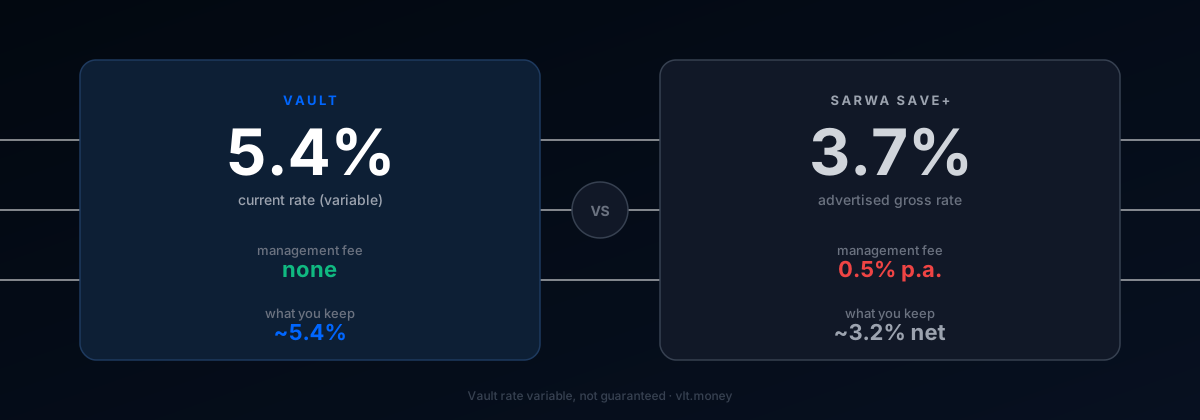
| Current rate | ~5.4% (variable) | 3.7% gross |
| Annual management fee | None | 0.5% p.a. |
| Rate you actually keep | ~5.4% | ~3.2% net |
| Lock-in period | None | None |
| Withdrawal timeline | Anytime | 3–5 business days (funds are invested; liquidation required before transfer) |
| Withdrawal restrictions | None | Can only withdraw to a bank account previously used to fund via wire transfer |
The management fee is the part that gets lost in most comparisons. Sarwa advertises 3.7%. What lands in your account after their 0.5% annual fee is closer to 3.2%. On a $10,000 balance, that's roughly $50 per year leaving your account quietly. On $50,000, it's $250.
Vault charges no management fee. The ~5.4% figure is what you earn, not a pre-fee headline.
Where the return actually comes from
This is where the two products differ most.
Sarwa Save+ holds your money in the Pictet Short-Term Money Market USD-I fund. This is a well-regarded institutional fund — US Treasury bills, agency paper, investment-grade commercial paper. It's safe and liquid. It also tracks the US Federal Reserve rate closely. When the Fed cuts rates (as it did three times in 2025), Sarwa's rate falls with it. Sarwa Save+ peaked at 5.1% in June 2024 when Fed rates were at 5.25%. It has declined since.
Vault earns its return from fees paid by institutional borrowers in a vetted institutional lending market. This is not a money market fund. The rate isn't tied directly to the Fed funds rate — it's set by supply and demand from institutions borrowing capital. That means it follows a different cycle than traditional savings products.
Neither mechanism is risk-free. Vault's rate is variable and not guaranteed. But they respond to different conditions.
Regulatory status
Sarwa is a licensed firm: Category 3C investment manager under the FSRA (ADGM) and separately licensed by the DFSA (DIFC). It has been operating since 2018. That dual-licence structure is a genuine differentiator.
One public item worth knowing: in May 2024, Sarwa received fines from both regulators totalling approximately $313,000. The violations related to a share subscription offer made to users without an approved prospectus and to findings of "misleading impressions" about financial performance. All affected subscriptions were reversed. This is on public record.
Vault is pursuing ADGM regulatory authorisation. It is not yet licensed. That's a meaningful difference. If regulatory status is your primary filter, Sarwa currently has the stronger position.
Onboarding and access
Sarwa has integrated UAE Pass, which enables near-instant onboarding with near-100% approval for eligible residents. AED transfers work via Lean Technologies (open banking from UAE banks). If friction-free local banking access matters to you, Sarwa has invested heavily here.
Vault is built for simplicity — no specialist knowledge required — but onboarding is at an earlier stage. The app is in waitlist phase.
A note on Sarwa's Halal option
Sarwa also offers a Save Halal product (Emirates Islamic money market fund) at 4.0% gross — approximately 3.5% net after the same 0.5% fee. As of March 2026, the Halal option actually pays more than the conventional Save+ product. For users seeking an Islamic-compliant savings option, this is worth noting — though Vault's ~5.4% still leads by roughly 190 basis points net even against Sarwa's best rate.
Sarwa's honest strengths
Sarwa has been operating in the UAE for eight years. It manages over $800M in client assets. The Save product does what it says. UAE Pass integration is genuinely useful. If you want a licensed, operating product today with a local banking experience, Sarwa is a real option.
Where Vault leads
- Net rate. ~5.4% vs ~3.2% after fees — roughly 220 basis points more in your account.
- No fee drag. A 0.5% annual fee compounds quietly. There's no equivalent on Vault.
- Different earnings mechanism. Not purely Fed-rate-dependent. When traditional savings rates continue declining (the direction of travel given UAE base rate cuts in 2025), Vault's rate is set by a different market.
The honest summary
If you want a fully licensed, operational product today with deep UAE banking integration: Sarwa is a reasonable choice.
If you want a higher net rate with no fee drag, and you're comfortable being an early user of a product pursuing regulatory approval: Vault is worth considering.
The ~5.4% Vault rate is variable and not guaranteed. The Sarwa rate is also variable — and has been declining since 2024.
Both products let you withdraw, but the mechanics differ. Sarwa Save+ requires liquidation before funds transfer — Sarwa's help center puts this at 3–5 business days — and withdrawals can only go to a bank account previously used to fund the account via wire transfer. Vault: no lock-in, withdraw anytime. The difference is in what you keep and how long it takes to get there.
Join the waitlist at vlt.money
Related reads
- Sarwa Alternatives UAE 2026 — other options if Sarwa's rate isn't enough
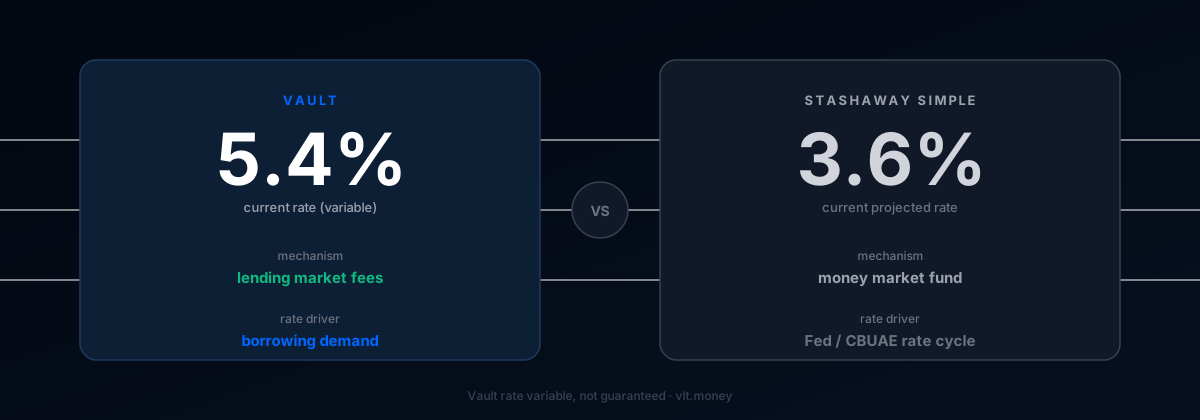
- Vault vs StashAway Simple UAE — the other major no-lock-in comparison
- UAE Savings Account Fees vs Net Rate — why the advertised rate isn't what you keep
- Best Savings Accounts UAE 2026 — full market comparison