The savings rate advertised in a headline is not always the rate you earn.
Some UAE savings platforms show 3.7% or higher. What they don't headline is the annual management fee sitting on top — typically 0.5% or more. That fee comes straight out of your return.
Here's what that means in practice.
Gross vs. net: the number that actually matters
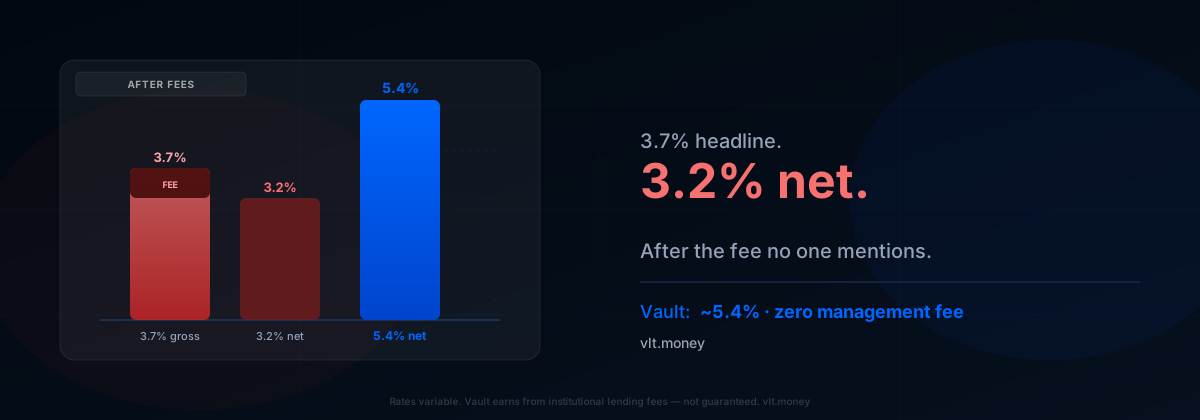
A platform charging a 0.5% annual management fee on a 3.7% gross rate delivers approximately 3.2% net to you.
That's not a rounding error. On a $10,000 deposit, the difference is around $50 per year. On $50,000, it's $250 per year — money that leaves your account and funds the platform's operations instead of your savings.
On a $100,000 deposit: roughly $500 per year in fees.
Management fees compound quietly. Over five years, a 0.5% annual drag at those deposit sizes adds up to thousands of dirhams that never appear as a line-item anywhere. They just reduce your actual return.
The right number to compare across platforms is always the net rate after all fees.
Why some rates are built to decline
It matters not just what a savings rate is today, but what drives it.
Some UAE savings products use money market funds as the underlying asset — short-term government bonds, treasury bills, and highly-rated commercial paper. These instruments track central bank interest rates. When the Federal Reserve or CBUAE cuts rates, these funds earn less. The savings rate follows.
The UAE saw this play out in 2024 and 2025. Several platforms that were paying 4.5–5%+ during the high-rate period have since seen their rates compress meaningfully. That's not mismanagement — it's how the underlying mechanism works. But it's worth understanding before you deposit.
A savings product tied to a rate-tracking fund will always drift downward in an easing cycle. The question is whether the rate you're shown today is the rate you're likely to earn next year.
A different earnings mechanism
Not all savings rates are built the same way.
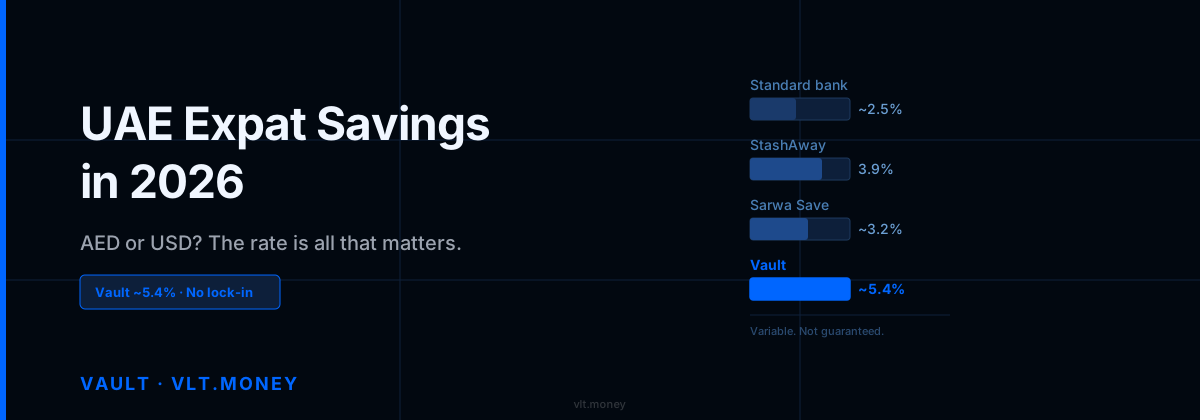
Vault's ~5.4% current rate comes from fees paid by institutional borrowers in a vetted institutional lending market where businesses and institutions borrow against collateral. That rate is driven by borrowing demand, not by a central bank decision. It's variable, and it can move in either direction. But it's not mechanically tied to Fed rate decisions in the same way a money market fund is.
Vault charges zero management fee. The rate you see is the rate you earn.
What to actually compare
When evaluating any savings product in the UAE:
- Net rate: subtract all management and platform fees from the headline rate
- Fee structure: annual management fees are often buried in pricing pages, not the main product page
- Earnings mechanism: money market fund (Fed-linked and declining), or something else?
- Withdrawal terms: is there a lock-in, a notice period, or minimum balance requirement attached to the rate?
A product showing 3.7% gross with a 0.5% fee is delivering 3.2% net. A product showing 5.4% with zero fee is delivering 5.4% net. The gap is 220 basis points — real money on any meaningful deposit.
Vault: ~5.4% current, zero management fee. Fees from institutional borrowers. Withdraw anytime.
Join the waitlist at vlt.money
Vault earnings are fees paid by institutional borrowers — not guaranteed returns. Rates are variable. Vault is in the process of obtaining ADGM regulatory approval.