What happens at a bank
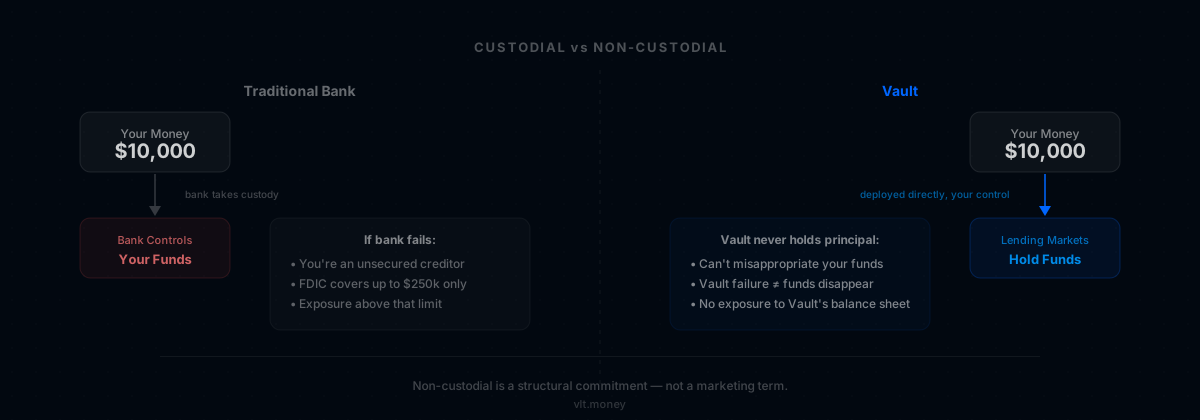
When you deposit money at a bank, the bank takes legal ownership of your funds. You have a legal claim against the bank, but the bank controls the money. If the bank fails, you become an unsecured creditor — protected by deposit insurance up to a limit, exposed above it.
This is why "your money is safe at the bank" always comes with an asterisk. In the UAE, the Deposit Insurance Corporation (DICORP) covers balances up to AED 500,000. Above that threshold, exposure is to the bank's balance sheet.
The bigger point: when you deposit with a bank, you're trusting the institution. You're not retaining any direct relationship with where the money goes.
What's different with Vault
Vault never takes possession of your principal. When you deposit funds, they go directly into lending markets under your account — Vault manages the deployment, but we don't hold the underlying money.
In practice, this means:
- Vault cannot misuse your principal
- An operational failure at Vault does not mean your funds disappear
- You are not exposed to Vault's balance sheet
Your money isn't sitting in a Vault account. It's working in a lending market, earning fees from institutional borrowers, with Vault acting as the manager — not the custodian.
What Vault does control
We're transparent about our role:
- Market selection: We choose which lending markets your deposits go into
- Rebalancing: We move funds between markets to maintain earnings and liquidity
- Withdrawals: We process your withdrawal requests and ensure timely settlement
These are operational responsibilities — not ownership of your assets.
How this compares
| Structure | Who holds your funds? | Risk if provider fails |
|---|---|---|
| Traditional bank | Bank takes custody | DICORP-covered up to AED 500K |
| Brokerage | Custodial | Depends on structure and regulation |
| Vault | Funds held in market, not by Vault | Markets hold funds directly |
The distinction matters in a failure scenario. If Vault had a serious operational problem tomorrow, the funds deployed in lending markets don't evaporate. They sit in the market, still earning, accessible once any operational issues are resolved. Vault's failure is not the same as your money disappearing.
On audited markets
The lending markets Vault deploys into have been independently reviewed by third-party security firms. These reviews cover collateral management, liquidation mechanisms, and technical infrastructure.
Audits are not guarantees. No review catches every failure mode. But they are a meaningful signal of operational maturity — and they're one of the criteria we use when selecting which markets to use at all.
What this means for trust
The question "can I trust this company with my money?" is different when the company doesn't actually hold your money.
With a bank or a traditional savings app, trust is in the institution. With Vault, trust is distributed: trust in Vault's market selection, trust in the market's own infrastructure, and trust that the fee mechanism is what we say it is.
We think that's a better structure. It removes the single point of failure that comes from any one institution holding your balance.
Join the waitlist at vlt.money
Vault earnings are fees paid by borrowers for access to capital — not guaranteed returns. Rates vary with market conditions. Withdrawals processed within 24 hours. Vault is in the process of obtaining ADGM regulatory approval.