Pakistani nationals are one of the largest expat communities in the UAE — over 1.5 million people, working across professional services, construction, retail, and entrepreneurship. Many maintain financial ties to Pakistan while building careers and savings in the UAE.
The challenge: Pakistan's economic environment has changed significantly, and navigating savings across two countries takes some planning.
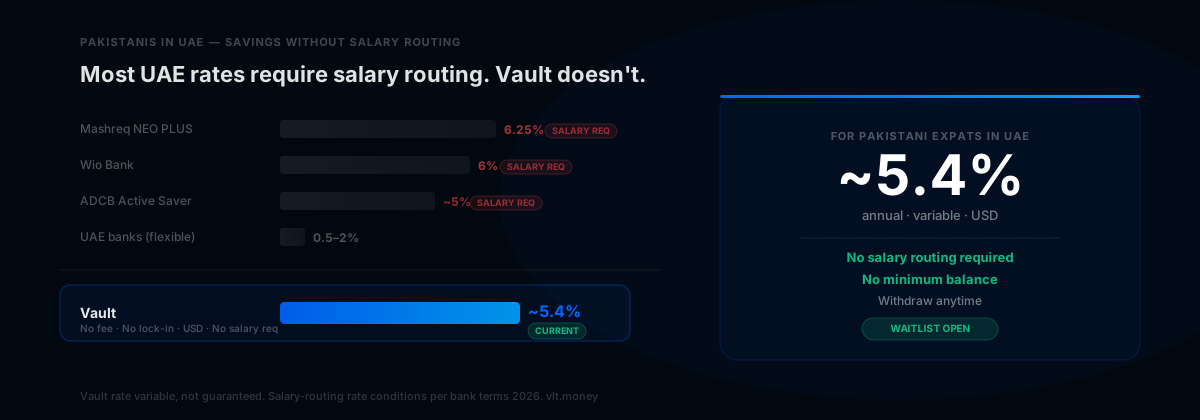
The salary routing trap
The most competitive UAE savings rates are conditional:
- Mashreq NEO PLUS (6.25%): Requires AED 10,000/month salary routing (max 2 debits/month or you earn 0%)
- Wio Bank (up to 6%): Requires Salary or Family plan with active monthly salary routing
ADCB's 5% Active Saver campaign ended March 2025. ADCB now has a live Super Saver at up to 4.5% AED — but only on balances of AED 50,000 or more, and only on new external money that also increases your total ADCB relationship balance. Below AED 50,000, you earn 0.01%.
If your employer pays into a bank you didn't choose, or you receive client payments through multiple channels, you typically can't meet these conditions. You fall to the base rate — usually 0.5–2%.
What Pakistani expats earn at UAE banks without conditions
| Bank | Flexible savings (no salary req) |
|---|---|
| Emirates NBD | 1.0–1.25% standard; Apr–Jun 2026 promo 2.5–2.75% (new money only; 5% headline requires AED 10M+) |
| FAB iSave | ~2.5% standard; 4% on new funds until Jun 30, 2026 |
| ADCB | 0.5–1% standard; up to 4.5% Super Saver (AED 50K+, new external money only) |
| Standard Chartered | 0.5–1% |
| Meezan Bank UAE | Islamic savings (profit rate varies) |
| Wio flexible | 2.75% USD / 3.25% AED |
FAB iSave pays 4% on new external funds until June 30, 2026 — existing depositors earn ~2.5% standard. Across all banks, standard flexible rates without conditions remain low.
Roshan Digital Account — Pakistan's cross-border savings option
Pakistan's State Bank launched the Roshan Digital Account (RDA) specifically for overseas Pakistanis. It allows Pakistanis abroad to hold PKR and foreign currency (USD, GBP, EUR) accounts with major Pakistani banks including HBL, MCB, UBL, and Bank Alfalah.
Key points for UAE-based Pakistanis:
- Naya Pakistan Certificate (NPC): Offers dollar profit rates around 5–7% on USD deposits — competitive, but in a Pakistani bank, not a UAE one
- Currency risk: If you plan to spend in the UAE, holding PKR exposes you to PKR/AED exchange fluctuations
- Repatriation: RDA funds are freely repatriable — a genuine advantage
- Risk profile: Pakistani banking sector is regulated by the State Bank, but country risk applies for someone spending in the UAE
The trade-off: RDA is excellent for Pakistanis planning to return. For those planning to stay in the UAE long-term, keeping savings in PKR in Pakistan while spending in AED/USD introduces currency risk that erodes returns.
Islamic banking in the UAE
A significant portion of Pakistani expats prefer Sharia-compliant financial products. The UAE has robust Islamic banking options:
- Dubai Islamic Bank (DIB): Islamic savings with profit rates typically 1–3%
- Abu Dhabi Islamic Bank (ADIB): Comparable profit rates
- Meezan Bank UAE: Pakistan-linked Islamic bank with UAE presence
- Emirates Islamic: Part of Emirates NBD Group, full Sharia-compliant savings range
These are solid, regulated options — but profit rates on standard Islamic savings accounts in the UAE are broadly similar to conventional bank rates, in the 0.5–2.5% range for flexible accounts.
Options that work without salary routing
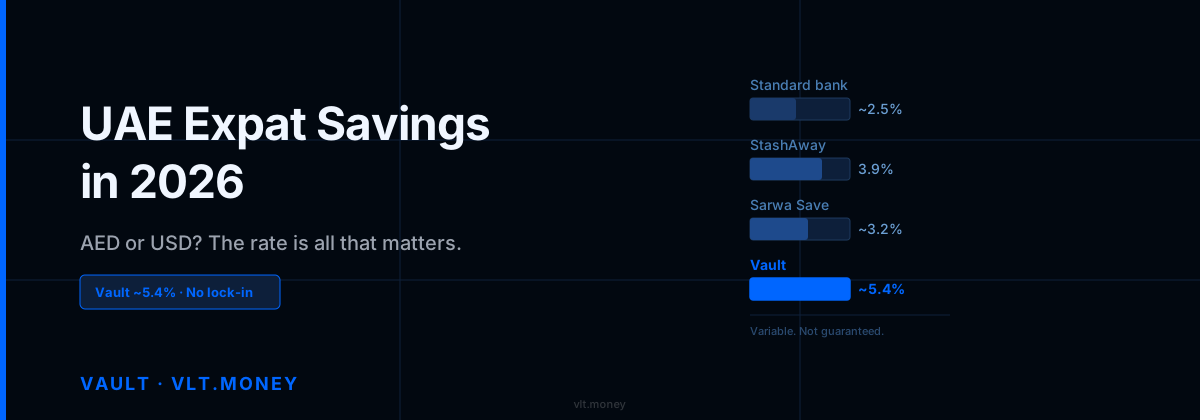
StashAway Simple UAE — 3.6%
UAE-regulated (DFSA-licensed) money market fund. No minimum, no lock-in. Rate tracks US Federal Reserve — will move with Fed decisions. No salary requirement, no fee.
Sarwa Save+ — ~3.2% net
ADGM and DFSA regulated. Gross rate 3.7%; net 3.2% after 0.5% annual fee. Conventional savings instrument (not Sharia-compliant — Sarwa has a separate Halal product at ~3.5% net for Islamic-preference investors).
Vault — ~5.4% (pre-launch, pursuing ADGM approval)
Vault earns from fees paid by institutional borrowers in vetted lending markets — independent of Fed rate decisions. No salary condition, no minimum, no fee, no lock-in. USD-denominated.
Important: Vault is pre-launch and not yet ADGM-licensed. It is not currently Sharia-certified. Higher potential return comes with higher risk than a licensed, regulated product. Suitable for those comfortable with early-stage fintech.
→ Join the waitlist at vlt.money
Comparison: UAE vs. Pakistan savings options
| Option | Rate | Currency | Regulated | Notes |
|---|---|---|---|---|
| Vault | ~5.4% | USD | Pursuing ADGM | Pre-launch |
| Naya Pakistan Cert (USD) | ~5–7% | USD | State Bank Pakistan | Pakistan bank risk |
| StashAway Simple | 3.6% | USD/AED | DFSA UAE ✓ | Fed-linked |
| Sarwa Halal | ~3.5% net | USD/AED | ADGM/DFSA UAE ✓ | Islamic |
| Sarwa Save+ | ~3.2% net | USD/AED | ADGM/DFSA UAE ✓ | Conventional |
| UAE Islamic savings | 1–3% | AED | CBUAE ✓ | Sharia-compliant |
| UAE bank standard | 0.5–2% | AED/USD | CBUAE ✓ | Conditional |
The idle capital problem
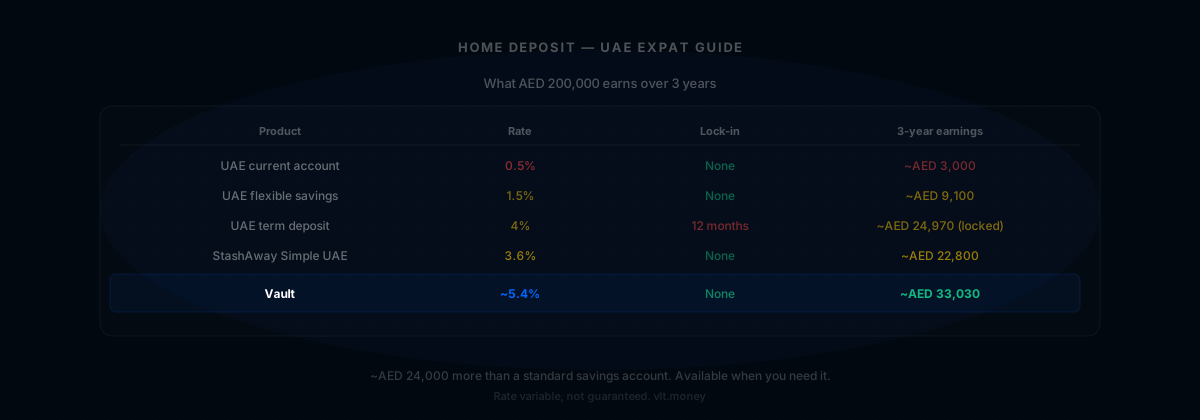
Many Pakistani expats accumulate savings between remittances — holding AED or USD in a current account waiting for the right moment to send money home or invest. That idle period, which can be weeks or months, is earning almost nothing at a standard UAE bank rate.
On AED 30,000 sitting idle for 12 months: the difference between 1% (bank) and 5.4% (Vault) is approximately AED 1,260 — that's a one-way flight home, or two months of school fees.
Related reads
- Why UAE Expats Are Leaving Money on the Table — the savings gap explained
- Best Savings Account for Indians in the UAE — guide for the largest UAE expat community
- Best Savings Account for Filipinos in the UAE — OFW-specific guide
- Vault vs Sarwa Save — detailed rate and fee comparison
- Best Savings Accounts UAE 2026 — full UAE comparison
Rate data current as of March 2026. All rates are variable. Vault is pre-launch and not yet ADGM-licensed. Naya Pakistan Certificate rates change periodically — verify at your bank. This is not financial advice.