Indians are the largest expat community in the UAE — over 3.5 million people. But most UAE savings products are designed around one assumption: your salary arrives in a UAE bank account every month.
If you're freelance, remote, or receive transfers from India, that assumption breaks almost every competitive savings option in the market.
Why most "high-rate" UAE accounts don't work for Indian expats
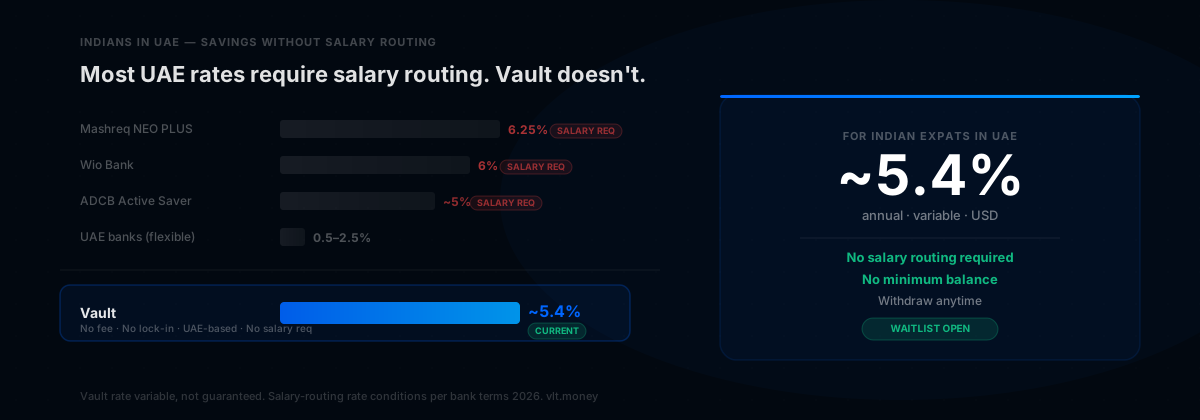
The top-advertised rates in UAE banking come with salary routing conditions:
- Mashreq NEO PLUS Saver (6.25%): Requires AED 10,000/month salary transfer to Mashreq. There is also a non-salary tier at 5% — but it requires AED 50,000+ average monthly balance and limits you to 2 free withdrawals per month.
- Wio Bank (up to 6%): Requires Salary or Family plan with active monthly salary routing
ADCB's 5% Active Saver campaign ended March 2025. ADCB now has a live Super Saver at up to 4.5% AED — but only on balances of AED 50,000 or more, and only on new external money that also increases your total ADCB relationship balance. Below AED 50,000, you earn 0.01%.
If your income arrives in USD, comes from clients in India, or is remitted through Wise or a multi-currency account, you cannot meet these conditions. You earn the base rate — typically 0.5–2%.
What Indian expats in UAE actually earn at the bank
Without salary routing, the realistic rates at major UAE banks are:
| Bank | Flexible savings (no salary req) |
|---|---|
| Emirates NBD | 1.0–1.25% standard; Apr–Jun 2026 promo 2.5–2.75% (new money only; 5% headline requires AED 10M+) |
| FAB iSave | ~2.5% standard; 4% on new funds until Jun 30, 2026 |
| ADCB | 0.5–1% standard; up to 4.5% Super Saver (AED 50K+, new external money only) |
| Standard Chartered | 0.5–1% |
| RAKBank | 1–1.5% |
| Wio flexible | 2.75% USD / 3.25% AED |
FAB iSave pays 4% on new external funds until June 30, 2026 — existing depositors earn ~2.5% standard. The broader point is that most UAE savings rates are much lower than the headline promos suggest.
What's different about Indian expat financial needs
A few patterns are specific to Indian expats in UAE:
Dual-currency savings: Many Indian expats hold both AED (for UAE expenses) and USD (for remittances or future goals). USD savings rates at UAE banks are consistently lower than AED rates.
NRI accounts: Many Indian expats maintain NRE (Non-Resident External) accounts in India that allow repatriation of funds. These pay Indian fixed deposit rates, which have been 6–7% on rupee deposits. However, these are INR-denominated — if you plan to spend in the UAE or a USD-pegged economy, currency risk applies.
Remittance timing: Many Indian expats accumulate savings in UAE before sending lump sums to India. The time between accumulation and remittance — often 3–12 months — is idle earning time. A 4-percentage-point difference on a $30,000 balance over 6 months is $600 that most people are leaving uncaptured.
The options that actually work without salary routing
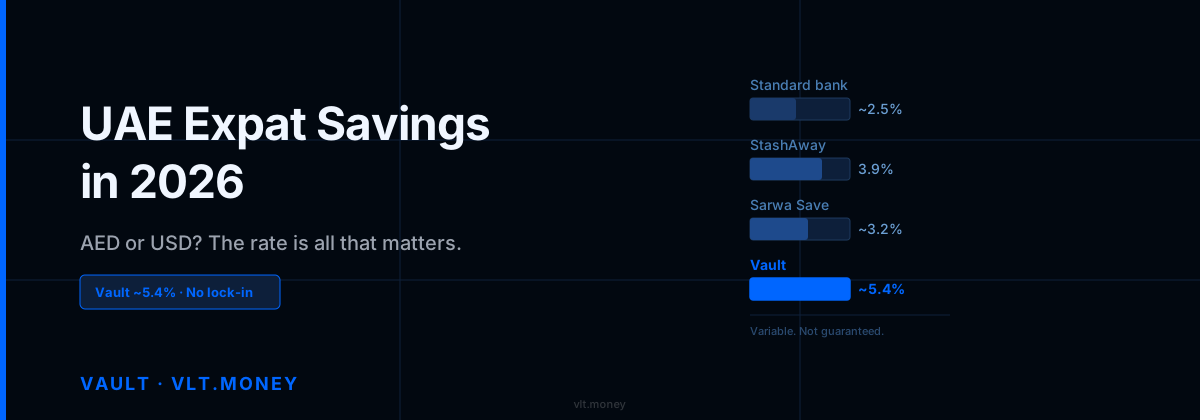
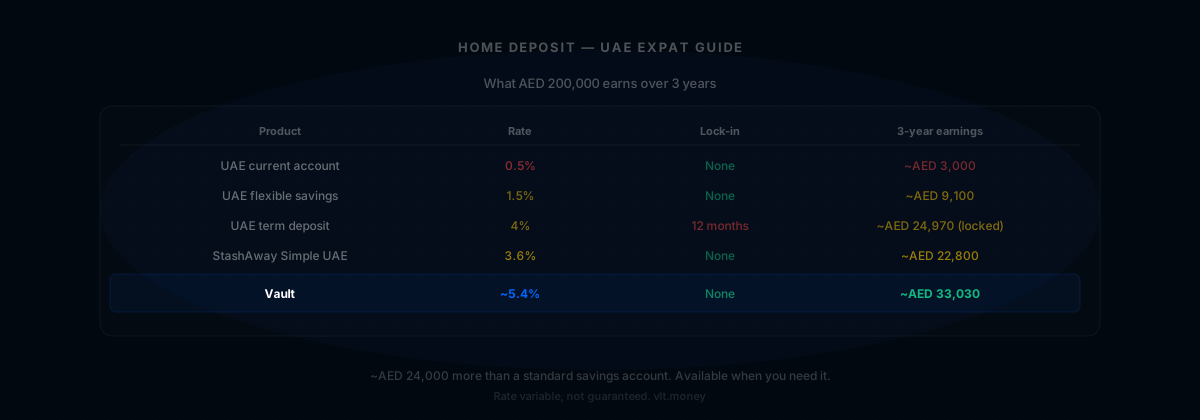
StashAway Simple UAE — 3.6%
A UAE-regulated money market fund (DFSA-licensed). No minimum, no lock-in, AED or USD. The rate tracks the US Federal Reserve — it will decline as the Fed cuts rates.
Good for: Risk-averse savers who want DFSA oversight.
Sarwa Save+ — ~3.2% net
Regulated by both ADGM and DFSA. Charges a 0.5% annual fee on top of a 3.7% gross rate, resulting in ~3.2% net. Uses Pictet money market funds — same Fed-tracking mechanism as StashAway.
Good for: People who already use Sarwa for investments.
Fixed deposits at Wio Bank or SIB — 4–4.25%
Available with 12-month lock-in. Not suitable if you might need funds for remittance within the year.
Vault — ~5.4% (pre-launch, pursuing ADGM approval)
Vault earns from fees paid by institutional borrowers in vetted lending markets — a different mechanism from money market funds. No salary conditions, no minimum, no fee, no lock-in. USD-denominated.
The rate doesn't track the Fed — it tracks institutional borrowing demand. This makes it more resilient to UAE base rate cuts.
Important: Vault is pre-launch and not yet ADGM-licensed. It carries more risk than StashAway or Sarwa. It is appropriate for people comfortable with early-stage fintech products and who understand the risk profile.
What about NRE/NRO accounts in India?
NRE fixed deposits in India currently offer 6–7% on INR — higher in rupee terms. However:
- The INR has depreciated approximately 2–3% per year against the USD over the past decade. This erodes the real USD return.
- Repatriation from NRO accounts has limits (up to $1M per year with Form 15CA/15CB)
- NRE accounts allow full repatriation, but require income to be earned outside India — UAE income qualifies
For savings you plan to keep in USD or AED, UAE-based options are generally better. For savings you'll eventually use in India, NRE accounts make sense.
The practical setup for Indian expats
A reasonable structure for 2026:
UAE current account (FAB/ADCB/Emirates NBD): Keep 1–2 months of UAE expenses here. Salary goes here if applicable.
USD savings for UAE goals: StashAway Simple (3.6%, regulated) or Vault (~5.4%, higher rate, pre-launch risk). For an emergency fund or house deposit savings in USD.
NRE account in India: For savings destined for India — SBI or HDFC NRE fixed deposits. Rupee-denominated, so keep only what you plan to spend in India.
Wise or Revolut: For FX conversion and cross-border transfers — not for holding savings (pays 0% in UAE).
The bottom line
If you don't have a UAE salary to route, you're not locked out of competitive savings rates — but you do need to look beyond the headline bank rates.
StashAway Simple at 3.6% is the lowest-friction regulated option. Vault at 5.4% offers a higher rate but is pre-launch. The gap between UAE standard savings (1–2%) and these options is material: on AED 100,000 ($27,000), the difference between 1.5% and 5.4% is over AED 14,000 per year.
Related reads
- Why UAE Expats Are Leaving Money on the Table — the mechanics of the savings gap
- Best Savings Account for Pakistani Expats in the UAE — similar guide for Pakistani expats
- Best Savings Account for Filipinos in the UAE — OFW-specific guide
- Best Savings Accounts UAE 2026 — full UAE comparison across all options
- UAE Savings Account Fees vs Net Rate — why the gross rate isn't what you keep
Rates current as of March 2026. Vault is in the process of obtaining ADGM regulatory approval and is not yet licensed. ~5.4% is variable and not guaranteed. This article is for informational purposes and not financial advice.